The Slow Strangulation of Justice
How Gutting the DOJ's Civil Rights Division Brings Back 'States' Rights' Terrorism

"States' rights" has always been code for "the right to oppress without federal interference." Project 2025 doesn't use those exact words, but when you strip away the policy language, that's exactly what you can see from their plans to radically gut the Department of Justice's Civil Rights Division.
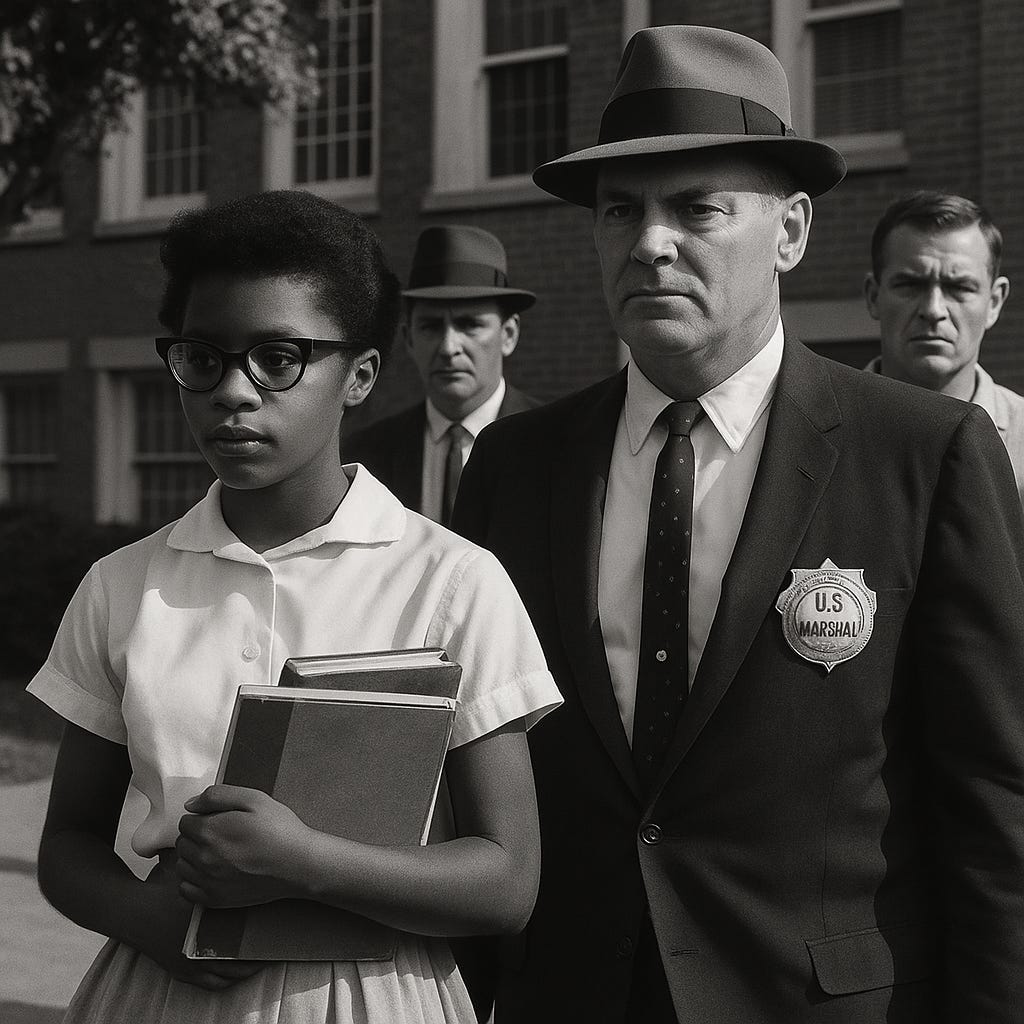
A friend’s mom won't eat at certain restaurants in small-town Alabama, even though it's been nearly sixty years since legal segregation ended. When I asked her why, she told me about the federal marshals who had to escort her to high school every morning in 1963, and how quickly those same white business owners who smiled at federal agents returned to their old ways once the attention moved elsewhere.
"That protection," she told me, "is the only thing that ever made them act right. And even then, only when they thought somebody was watching."
Her words echo in my mind as I read through Project 2025's proposals for the Department of Justice. The document's authors understand something that civil rights advocates sometimes forget: institutional change without enforcement is just paper and promises. They're betting that if they can eliminate effective federal civil rights enforcement, state and local authorities will likely return to their old ways of handling Black people's demands for equality.
What the Civil Rights Division Actually Does
Before we can understand what we might lose, we need to understand what the Civil Rights Division actually does beyond the high-profile cases that make headlines. Most Americans think of the Division primarily in terms of historic moments like Little Rock Central High School, Selma to Montgomery, James Byrd Jr.'s murder investigation. But the Division's daily work involves the mundane, essential business of making civil rights real in American life.
Every week, the Division investigates complaints about police departments that systematically brutalize Black residents. It reviews hiring practices at companies that somehow never seem to find qualified Black applicants. It examines school districts where Black children are suspended at rates five times higher than white children for the same behaviors. It scrutinizes voting changes that might dilute Black political power.
This work rarely generates headlines, but it shapes the daily experiences of millions of Black Americans. When a police department signs a consent decree requiring bias training and community oversight, that's the Civil Rights Division's work. When a corporation changes its hiring practices after a discrimination investigation, that's the Division's influence. When a school district modifies disciplinary policies that were pushing Black children out of classrooms, that's federal civil rights enforcement in action.
Project 2025 proposes to drastically reduce this enforcement capacity, arguing that such federal intervention represents overreaches that infringe on state and local authority. This framing deliberately obscures the reality that federal civil rights enforcement exists precisely because state and local authorities have historically been unwilling or unable to protect the rights of Black citizens.
The Pattern Recognition Problem
The Civil Rights Division's greatest strength lies in its ability to identify patterns of discrimination that might appear random or isolated when viewed individually. A single complaint about police misconduct might reflect an individual officer's behavior, but hundreds of similar complaints from the same department suggest systematic problems requiring systematic solutions.
Local authorities often lack the perspective, resources, and/or political will to identify these patterns. Police chiefs may genuinely believe their departments treat everyone fairly, even when statistical evidence suggests otherwise. School superintendents might insist their disciplinary policies are colorblind while data shows clear racial disparities in enforcement. City officials may see individual housing discrimination complaints as isolated incidents rather than evidence of broader patterns and systemic problems.
Federal enforcement provides the institutional capacity to connect dots that local authorities miss or prefer to ignore. The Civil Rights Division can compel data collection, conduct comprehensive investigations, and mandate changes that address root causes rather than individual symptoms.
Project 2025's proposed cuts would eliminate much of this pattern recognition capacity, leaving communities to address discrimination complaint by complaint, incident by incident, without the resources or authority to tackle systematic problems.
The Consent Decree Revolution
Perhaps nowhere is the Division's impact more visible than in police reform through consent decrees. Consent decrees are court-enforced agreements that require departments to implement specific changes under federal supervision. Since the 1990s, consent decrees have transformed dozens of police departments, reducing excessive force, improving community relations, and saving both civilian and officer lives.
These agreements typically require departments to collect and analyze data on police stops, searches, and use of force; implement bias training and community policing strategies; establish civilian oversight mechanisms; and submit to ongoing federal monitoring. While imperfect, consent decrees have produced measurable improvements in police behavior and community trust.
The process works because it combines legal authority with technical assistance and long-term oversight. Departments that might resist voluntary reform find themselves required to change under court order, but they also receive federal resources and expertise to help implement improvements effectively.
Project 2025 proposes to severely limit the Division's ability to negotiate and enforce consent decrees, arguing that such agreements infringe on local law enforcement autonomy. This position ignores the reality that many police departments have entered consent decrees only after repeated instances of abuse that local authorities failed to address.
Without federal oversight capacity, police departments that have historically engaged in discriminatory practices would face little external pressure to change, essentially returning to the pre-civil rights era when local law enforcement operated with minimal accountability to Black communities.
Employment Discrimination and Economic Justice
The Civil Rights Division's employment discrimination work extends far beyond individual complaints to address systematic barriers that limit Black economic advancement. The Division investigates companies, unions, and government agencies that maintain hiring, promotion, or compensation practices that exclude or disadvantage Black workers.
This work often involves complex statistical analysis to identify patterns that might not be obvious in individual cases. For example, a company might hire Black workers at reasonable rates but consistently steer them toward lower-paying positions or departments. Individual employees might not recognize this pattern, but federal investigators can identify it through comprehensive data analysis.
Employment discrimination cases frequently result in changes that affect thousands of workers and reshape entire industries. When the Division investigates systematic discrimination in hiring, the resulting settlements often require companies to modify recruitment practices, provide back pay to affected workers, and implement monitoring systems to prevent future discrimination.
Project 2025's proposed restrictions on employment discrimination enforcement would make it much more difficult to address systematic workplace discrimination, essentially returning to a complaint-driven system where individual workers must challenge powerful employers without federal support.
Voting Rights Enforcement in Crisis
The Civil Rights Division's voting rights work has become increasingly crucial as state and local jurisdictions implement new restrictions that disproportionately affect Black voters. While the Supreme Court's Shelby County decision eliminated preclearance requirements, the Division retains authority to challenge discriminatory voting changes after they've been implemented.
This after-the-fact enforcement is less effective than preclearance, but it remains essential for protecting Black voting rights. The Division investigates voter purges, challenges discriminatory redistricting, and monitors elections in jurisdictions with histories of discrimination.
Project 2025 proposes to further limit this enforcement capacity, arguing that federal oversight of state election processes is unnecessary and intrusive. This position ignores the ongoing reality of voting discrimination and the Division's crucial role in protecting Black electoral participation.
Without effective federal voting rights enforcement, state and local jurisdictions would face minimal consequences for implementing discriminatory voting practices, essentially completing the rollback of Voting Rights Act protections that began with Shelby County.
Education and the School-to-Prison Pipeline
The Division's education work addresses some of the most entrenched forms of institutional racism in American society. Schools that discipline Black children more harshly than white children, districts that provide inferior facilities and resources to predominantly Black schools, and colleges that maintain discriminatory admissions or campus climate practices all fall within the Division's purview.
This work is particularly important because educational discrimination compounds over time, affecting not just individual students but entire generations of families. A Black child who is suspended repeatedly for minor infractions may fall behind academically, drop out of school, and face limited economic opportunities throughout life. Schools that fail to provide adequate resources to Black students perpetuate achievement gaps that affect college attendance, career prospects, and lifetime earnings.
Federal enforcement provides the only effective mechanism for challenging educational practices that might be perfectly legal under state law but violate federal civil rights protections. Local school boards often lack the will or political support to address discriminatory practices voluntarily, making federal intervention essential.
Project 2025's education proposals would significantly reduce the Division's capacity to investigate and remedy educational discrimination, leaving Black families with limited recourse when schools fail to provide equal treatment and opportunities.
Building Community-Based Enforcement
As federal civil rights enforcement potentially weakens, communities must develop independent capacity to document discrimination and pursue remedies through other channels. This represents both a defensive strategy against federal rollbacks and an offensive strategy for building long-term power.
Community organizations can develop expertise in civil rights law and investigation techniques, creating local capacity to identify and document discrimination patterns. While these organizations cannot compel the same remedies as federal enforcement, they can build cases for private litigation, create public pressure for change, and provide support for individuals facing discrimination.
Legal organizations specializing in civil rights work become increasingly important as federal enforcement capacity shrinks. Supporting these organizations through financial contributions, volunteer work, and case referrals helps maintain some enforcement capacity even when federal resources disappear.
Documentation and research capabilities allow communities to build evidence of discrimination that can support various forms of advocacy and legal action. When federal investigators are no longer available to conduct comprehensive discrimination studies, community organizations must develop these capacities independently.
Questions for Reflection
Have you or people in your community benefited from federal civil rights enforcement?
What forms of discrimination exist in your community that might require federal intervention to address effectively?
What organizations in your area work on civil rights issues, and how can you support their work?
The Civil Rights Division represents the institutionalization of hard-won victories from the civil rights movement. Its work transforms abstract constitutional principles into concrete protections for Black Americans navigating education, employment, housing, voting, and interactions with law enforcement.
Project 2025's attacks on civil rights enforcement represent an attempt to return to an era when Black people's rights existed primarily on paper, without institutional mechanisms to make them real in daily life. The response must combine defense of existing federal protections with development of independent community capacity to fight discrimination through multiple channels.
Federal civil rights enforcement has never been perfect or complete, but it has provided essential protection for Black communities seeking equal treatment under law. Losing that protection would represent a return to an era when "states' rights" meant the right to oppress without interference, a return we cannot afford to accept.