Resist
Your practical guide for resisting this bullshit

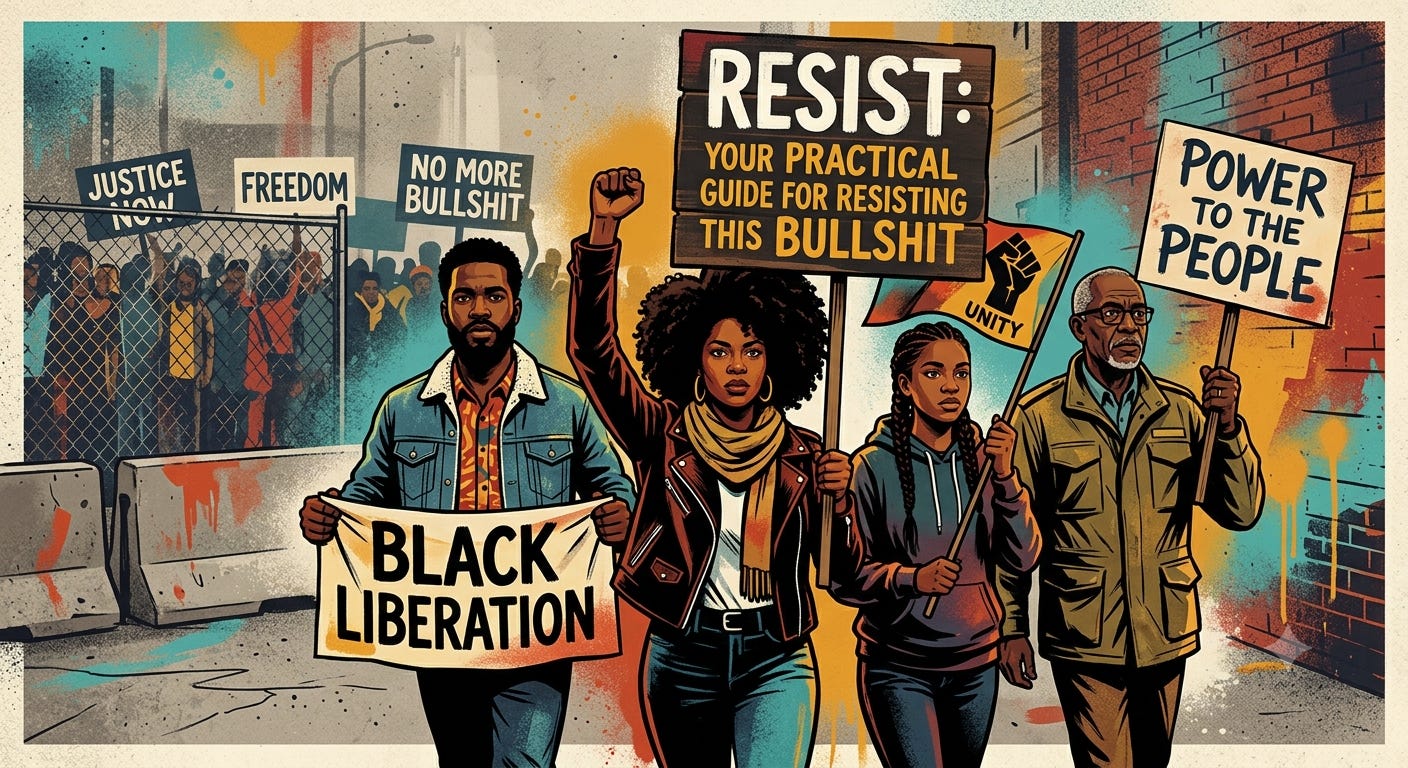
This series is called Resist for a reason, but not the reason you might expect. We are not resisting because we are losing. We are resisting because they have never stopped needing to fight us, and it is long past time we stopped fighting on their terms and started building on ours. Part One is the receipts. You cannot check out of a system you have not fully clocked, and most of us were never taught the whole architecture, just the sanitized highlight reel: a boat, a Proclamation, a March, a Dream. The real story is longer, uglier, funnier in the way gallows humor is funny, and it ends somewhere you were probably never told: they built the most powerful nation on earth around controlling us, and it still was not enough to control us.
The Obsession Before the Hatred
Before we get to the laws, sit with this: the fixation came first. Enslavers did not simply see Black people as property to be managed the way you’d manage a plow horse. They wrote obsessively, luridly, endlessly about Black bodies. They speculated in scientific journals about the size of skulls, the capacity for pain, the supposed hypersexuality of the people they were raping on a schedule. Thomas Jefferson, drafting the words “all men are created equal” with one hand, wrote an entire section of Notes on the State of Virginia theorizing about Black inferiority with the other, while fathering children with a woman he legally owned and could never marry. That is not incidental hypocrisy. That is the whole American formula: declare the ideal, deny it to us, and then write a book explaining why we deserved the denial.
This is the part that gets skipped: the hatred was never simple disgust. Disgust does not build an entire economy. What built the economy was a toxic, obsessive fascination, with Black labor, Black bodies, Black rhythm, Black style, Black language, that white America has never been able to look away from and has never been able to admit it wants. They stole the labor. Later they stole the music. Later they stole the dances, the slang, the walk, the swagger, and told the world they invented it. You cannot hate something you have spent two hundred fifty years copying, imitating, studying, and profiting from unless the hatred is really about something else: control. If they can own it, cage it, or launder it through Elvis and Iggy Azalea, it’s not that they hate Blackness. They hate not being able to control it. That distinction matters, because it tells you the entire system was never really about us being lesser. It was about them needing us contained, because a free Black population was living proof that their whole hierarchy was invented, not natural.
The First Draft: Slavery as Legal Architecture
Slavery in America was not an accident of history that everyone just sort of stumbled into. It was legislated, litigated, and insured. There were laws defining exactly how many lashes were legal, laws making it a crime to teach an enslaved person to read, laws that made a child’s legal status follow the mother specifically so that a white man raping an enslaved woman produced more enslaved property instead of free children with a claim on his name. Insurance companies underwrote slave ships. Banks that still operate today held enslaved people as collateral on loans. The cotton economy that made the United States a global economic power ran on unpaid, coerced Black labor for longer than it has run on anything else. Two hundred forty-six years of slavery versus about one hundred sixty years of whatever we want to call what came after. Do that math next time someone tells you it was a long time ago.
Round Two: Freedom, Immediately Followed by a Loophole
Then came the Thirteenth Amendment, and here is the part that should make your blood run cold and your eyebrows go up at the same time: it abolished slavery “except as a punishment for crime whereof the party shall have been duly convicted.” Read that again. The amendment that supposedly ended slavery built a legal exit ramp for a new one, and Southern legislatures drove a truck through it within months. They passed Black Codes, laws that criminalized unemployment, criminalized “insulting gestures,” criminalized simply walking around without proof of a labor contract, specifically so freed Black people could be arrested, fined, and then “leased” to the very plantations they had just been freed from. This is convict leasing, and it was, if anything, more brutal than chattel slavery in the immediate term, because a plantation owner who owned an enslaved person had at least some financial incentive to keep that person alive. A plantation that merely leased a convict for a season had no such incentive. There was always another Black man one bogus vagrancy charge away.
This is not ancient trivia. This is the direct, documented, legally uninterrupted ancestor of the prison system we have today, the one that currently holds Black Americans at roughly three times our share of the population, the one where one in five Black men born in this century is projected to spend time behind bars. Same loophole. Same amendment. Different decade.
Round Three: Jim Crow, Sundown Towns, and the Architecture of Exclusion
For about a century after Reconstruction collapsed, formal law dictated where Black people could sit on a bus, which water fountain we could drink from, which schools we could attend, and in thousands of towns across this country, whether we were legally allowed to still be standing on the sidewalk after the sun went down. Sundown towns had literal signs at the city limits. Entire counties in the North, not just the South, expelled their Black residents and then advertised themselves as “all white” as a selling point for decades. If you have ever wondered why so many American suburbs are still overwhelmingly white today, you are looking at the load-bearing wall of a house built by exclusion, not a coincidence of “where people happened to want to live.”
Then came redlining: government maps, drawn by the Home Owners’ Loan Corporation and enforced through the FHA, that marked Black neighborhoods in red ink as too risky for federally backed mortgages. This was not private prejudice. This was federal policy, stamped, filed, and enforced for decades, that systematically blocked Black families from the single biggest wealth-building tool in American history: the ability to buy a home and watch it appreciate. The homeownership gap between Black and white Americans today, forty-four percent of us own our homes compared to nearly seventy-three percent of white Americans, is not a mystery. It is larger now than it was in 1960, when redlining was still openly legal. Let that sink in. We have made less progress closing that specific gap in the decades since discrimination was outlawed than existed while it was still on the books.
Round Four: When We Built Anyway, They Burned It
Here is where the series really turns, because this is the part that gets almost entirely erased from the story, and it should make you furious in a very specific way: every single time Black communities managed to build real, self-sufficient wealth despite all of the above, it was destroyed by direct, organized violence, and the destruction was never accidental collateral damage. It was the point.
Greenwood, the district in Tulsa, Oklahoma known as Black Wall Street, had more than seventy Black owned businesses on a single block: hotels, theaters, law offices, a hospital. It existed because Black Tulsans, locked out of the white economy by segregation, built a fully circular one of their own, a dollar earned by a Black doctor spent at a Black grocer, banked at a Black bank. In thirty six hours over May 31 and June 1, 1921, a white mob, deputized and armed by the city itself, burned thirty five blocks to the ground, killed an estimated three hundred people, and left thousands homeless. Survivors filed over a million dollars in damage claims. Every single one was denied except a claim from a white pawnshop owner for guns that had been taken from his store to arm the mob. No reparations were ever paid. Economists who have studied the long-term data found that the massacre measurably reduced homeownership and occupational status for Black Tulsans for generations afterward. That is not a tragic footnote. That is the entire model: build something, and if it gets big enough to look like real independence, the state helps burn it down and then denies you the claim.
And it happened again, in a different form, in Philadelphia in 1985. MOVE, a Black liberation organization that the city considered a nuisance, was living in a rowhouse when the Philadelphia Police Department, with an actual bomb supplied in part by the FBI, dropped it from a helicopter onto the roof. The resulting fire was allowed to burn. Eleven people died, including five children. Sixty one homes in a Black neighborhood burned to the ground because the city decided the fire was an acceptable way to make a point. No one went to prison for it.
And in between and around all of this sits COINTELPRO, the FBI’s decades long covert program specifically aimed, in J. Edgar Hoover’s own words, at preventing the rise of a Black messiah who could unify and electrify the movement. The program surveilled, infiltrated, and discredited over two thousand organizations and two hundred fifty thousand individuals. It is directly implicated in the assassination of Fred Hampton, a twenty one year old Black Panther leader who was shot in his bed during a pre dawn raid built on floor plans an FBI informant had supplied. This was not rogue agents. This was policy, on paper, with a budget.
So What Do You Do With All This
You could read all of that and land in despair. That is not the point of telling it, and it is not the point of this series. The point is this: notice what the pattern actually proves. A system does not need two hundred fifty years, five constitutional amendments’ worth of loopholes, a domestic terrorism campaign, and an aerial bombing of its own citizens if it is actually winning. Winners do not have to keep re-arming. They built Black Codes because slavery alone was not permanent enough. They built Jim Crow because Black Codes were not permanent enough. They built redlining because Jim Crow was not permanent enough. They built the war on drugs because redlining was not permanent enough. Every single escalation is an admission that the previous one failed to fully contain us, because we kept building Greenwood, kept building the Panthers’ breakfast programs, kept building something worth burning down.
In Part Two, we look at what the current remix sounds like: the twenty first century version of the same old song, now produced with algorithms, “colorblind” policy language, and a maternal mortality rate that says the quiet part loud. In Part Three, we go back through everything we built anyway, Freedman’s mutual aid societies, Garvey’s Black Star Line, the Panthers’ clinics, so you understand this is not a new idea, it’s a return to one we already know how to run. Because the honest lesson of two hundred fifty years is not that they are unstoppable. It’s that we have never once actually stopped, and neither have they, which tells you everything about who’s actually exhausted here.